
A finished MS beam is not made by simply passing a flat piece of steel through rollers. The route starts with liquid steel, continues through casting, reheating, descaling, shaped rolling, cooling, straightening, cutting, and inspection, with each stage affecting the beam’s geometry and performance. By following that route, you can identify which semi-finished form feeds the mill and which production records matter when you buy or specify beams.
Key takeaways
- Continuous casting produces the billet, bloom, or beam blank that feeds the mill.
- Secondary metallurgy controls steel chemistry before casting begins.
- Reheating and descaling prepare cast steel for controlled rolling.
- Inspection, marking, bundling, and cutting confirm beams meet order requirements.
Liquid steel becomes the billet, bloom, or beam blank that feeds the mill
A structural-section rolling mill is fed by a solid semi-finished casting, usually made by continuous casting—not liquid steel. In the ms beam production process, this cast form is reheated and plastically deformed until its cross-section becomes an I or H shape.
| Type | What it means | Relevance to beam rolling |
|---|---|---|
| Ingot | A large cast block made in a mould, with quality variations possible during solidification. | An older starting form that needs breakdown rolling before section rolling. |
| Billet | A relatively small square or round semi-finished cast section. | Suitable for smaller sections, depending on its size and the mill design. |
| Bloom | A larger, usually square or rectangular semi-finished section. | A common feedstock for heavy beams and structural sections. |
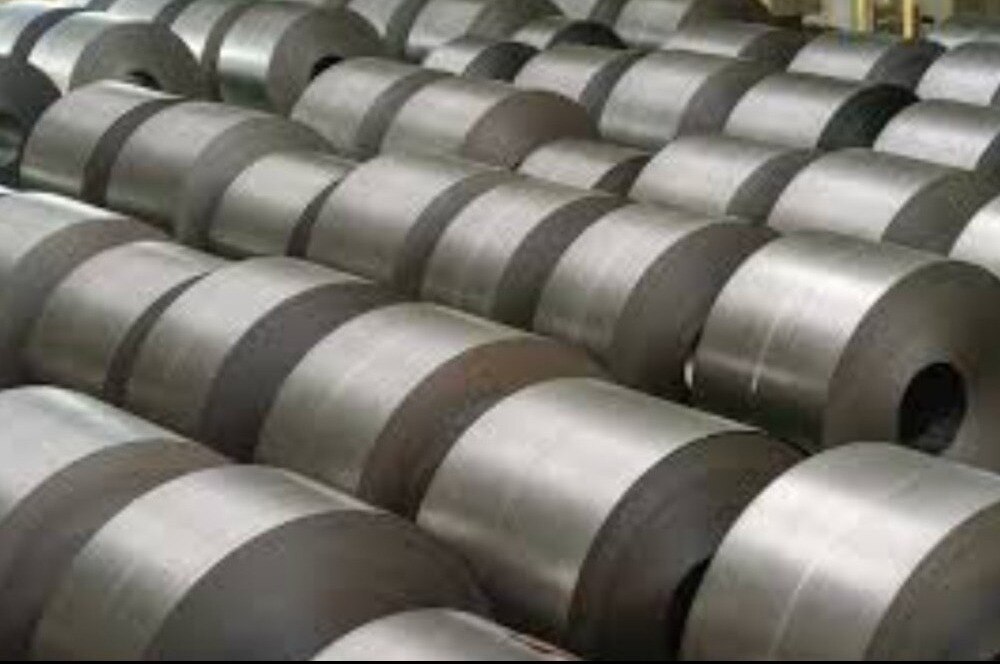
| Slab | A wide, flat rectangular casting intended mainly for plate or sheet rolling. | Not the normal direct feed for an I-beam mill. |
| Beam blank | A cast section already approaching an I or H shape, with steel concentrated near the future flanges. | Reduces the metal redistribution and rolling reduction required. |
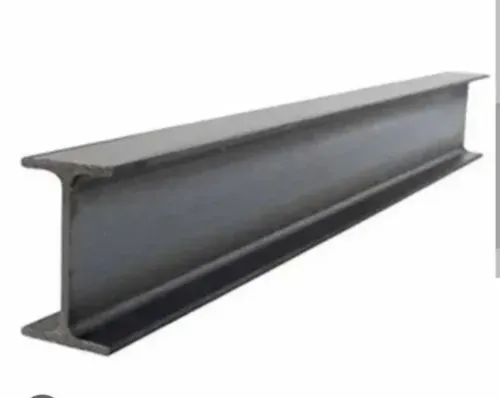
A finished beam is the rolled, dimensioned product, not a cast form. Unlike a welded built-up beam made from separate plates, it is one continuously rolled steel piece with no longitudinal welds or weld heat-affected zones.
That distinction is central to how ms beams are made; conventional blooms can also produce beams when the mill is designed for them.
Secondary metallurgy and continuous casting prepare the rolling stock
A rolling mill cannot fix chemistry that was wrong in the ladle or internal defects formed during casting. The early stages of how hot rolled steel becomes MS beams therefore control strength, weldability, cleanliness, and the stock’s starting shape.
1. Ironmaking and/or scrap melting produces liquid steel. Steelmakers set carbon, manganese, silicon, sulphur, phosphorus, and alloy additions to meet the intended grade.
2. In the ladle, secondary metallurgy adjusts composition and temperature through alloy trimming, argon stirring, and vacuum treatment when required. Stirring floats non-metallic inclusions into the slag; calcium treatment can modify alumina inclusions that would otherwise damage toughness or clog the casting nozzle.
3. Continuous casting transfers the treated steel through a water-cooled mould and secondary-cooling zone. The strand solidifies into a billet, bloom, or beam blank while withdrawal speed and cooling control cracks, segregation, and internal porosity.
4. Choose the cast section for the mill and size range. A conventional bloom has a solid, near-rectangular section that requires greater redistribution, while a beam blank already resembles an I or H profile and reduces deformation during the MS beam production process.
The caster then cuts the solid strand to charge lengths. Surface inspection and, where specified, ultrasonic examination identify cracks or internal discontinuities before reheating; rolling over a defective strand only hides the problem.
Reheating and descaling make the cast section ready for deformation
The reheating furnace raises the billet, bloom, or beam blank to a temperature that permits substantial plastic deformation and recrystallization. The correct discharge temperature depends on steel grade, section size, furnace design, and mill practice; one universal beam-rolling temperature is misleading.
Underheating increases rolling loads and limits shape control, while overheating or excessive furnace time enlarges grains, wastes fuel, and increases oxidation.
1. Charge the cast section into the furnace and heat it uniformly through its thickness, not merely at the surface.
2. Control the heating and discharge temperatures so the steel enters the mill hot enough to deform without cracking or overloading the rolls.
3. Apply high-pressure water descaling before the first pass and again between rolling stages when the process requires it.
Reheating creates mill scale, a layer of iron oxides on the steel surface. If operators leave it in place, the first rolls can press it into the metal, producing slivers, pits, laps, and a poor surface finish.
Removing it gives hot rolled MS beams a cleaner surface as how hot rolled steel becomes MS beams moves from cast section to formed profile. Residual scale can remain after rolling, but it is not durable corrosion protection and may need removal before painting, galvanizing, or welding.
Roughing, edging, and universal stands form the web and flanges together
A billet, bloom, or beam blank enters the roughing stand as a hot, compact section and leaves with the beginnings of an I or H profile. The rolls reduce the cross-sectional area while moving steel into the web and flange regions.
The pass sequence controls deformation:
- Breakdown passes reduce the original section and establish a stable rolling shape.
- Horizontal rolls compress the section vertically, reducing web and flange thickness while increasing its length.
- Vertical or edging rolls control flange width and limit sideways spread.
- Intermediate passes deepen the web and widen the flanges in measured steps.
- Universal stands use coordinated horizontal and vertical rolls to form the web and both flanges in the same operation.
- Finishing passes set the specified depth, flange width, web thickness, flange thickness, and fillet transitions.
A beam blank already resembles an I or H section, so the mill redistributes less metal than it would from a conventional bloom. The pass schedule prevents uneven filling, flange cracking, excessive spread, and mill overload. It also avoids forcing the final rolls to correct defects created earlier.
This is how ms beams are made in a hot rolled steel beam manufacturing line, not by welding separate plates. The ms beam production process creates one continuously rolled product; a fabricated beam has plate joints, welds, and heat-affected zones.
Final rolling establishes geometry, while cooling and steel chemistry influence the finished section’s strength and toughness.
Cooling, straightening, and cutting turn the rolled section into order lengths
After the finishing stand, the beam enters a cooling bed, where controlled handling lets heat leave without sections touching or stacking. Uneven cooling can lock in residual stress, producing camber or flange distortion even when the profile left the rolls correctly.
- Cool the beam at a controlled rate. Section thickness, steel chemistry, and cooling practice affect grain structure, strength, toughness, and residual stress.
- Straighten the cooled section with rollers to correct camber, sweep, and flange distortion. Straightening improves dimensional compliance but redistributes residual stress, so excessive correction can create new stress concentrations.
- Crop both ends to remove defective or nonconforming material, establish square ends, meet length tolerances, or remove portions reserved for test samples.
- Saw the acceptable section into order lengths. A hot saw, cold saw, abrasive saw, or shear is selected according to section size, temperature, mill design, and the required cut accuracy.
- Check length, straightness, end condition, and key dimensions before bundling. This final sequence in hot rolled steel beam manufacturing determines whether hot rolled MS beams arrive as usable, traceable lengths rather than merely correctly shaped profiles.
Inspection, marking, bundling, and dispatch determine whether the beam is ready to use
Do not accept hot rolled ms beams by appearance alone. Your purchase order must name the grade and product standard—such as ASTM A36/A36M with ASTM A6/A6M, or a specified EN 10025 grade—plus section designation, mass, length, dimensional tolerances, and quantity. “Mild steel” alone is not a complete specification.
Check these items against the order and mill documents:
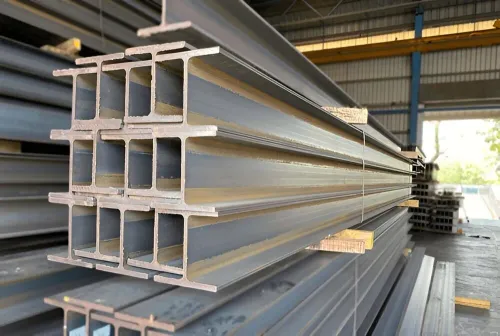
- Heat number, cast number, grade, section size, and manufacturer mark on every bundle
- Chemical analysis, tensile results, and bend or impact results when the grade or order requires them
- Web depth, flange width and thickness, straightness, length, end condition, and visible cracks, laminations, deep pits, or sharp burrs
- Mill test certificate, packing list, certificate of conformity, and traceability from each bundle to its heat
| Check | Accept when | Stop and clarify when |
|---|---|---|
| Ultrasonic testing | The order or standard specifies it and results are supplied | It is being treated as automatic for every beam |
| Surface condition | Mill scale is intact where permitted | Painting, galvanizing, or welding requires cleaned steel |
| Bundling and handling | Bundles are secured, lifted at supported points, and protected from bending | Loose beams, damaged tags, mixed heats, or dragging marks appear |
For how hot rolled steel becomes ms beams, this final traceability links the rolled section to its chemistry and tests. Bhartiya Metacast Private Limited can use the same checklist when supplying beams for fabrication or structural work.
Related product
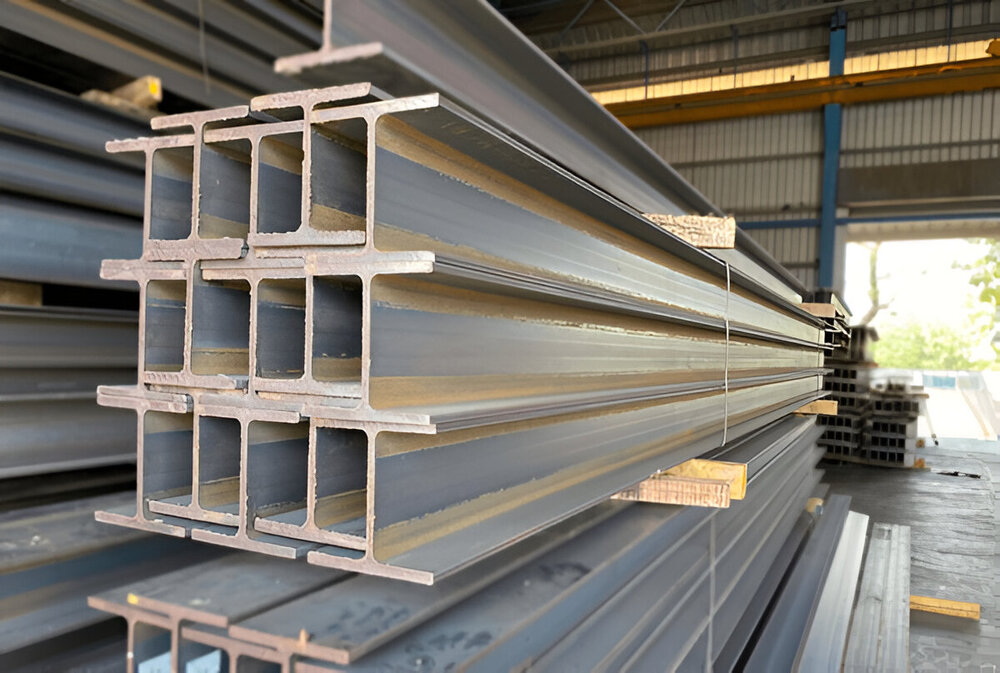 | MS Beams (Mild Steel Beams) – Bhartiya Metacast Private Limited Bhartiya Metacast Private Limited offers premium quality MS Beams (Mild Steel Beams)... View product → |
Frequently asked questions
What feeds a structural-section rolling mill?
A solid semi-finished casting, such as a billet, bloom, or beam blank, feeds the mill rather than liquid steel.
How is cast steel prepared for rolling?
The cast section is reheated to the required rolling temperature and descaled to remove surface oxide.
How do rolling stands form an MS beam?
Roughing, edging, and universal stands progressively form the web and flanges into an I or H cross-section.
What happens after the beam leaves the finishing stands?
The beam is cooled, straightened, cut into order lengths, inspected, marked, bundled, and dispatched.